
After the Season 8 finale of Outlander, a new wave of fan theories has taken over online discussions, shifting the focus away from the long-debated “ghost of Jamie Fraser” and toward a far more surprising idea — that Claire Fraser may not just be moving through time, but subtly influencing it.

Across Reddit threads and fan forums, viewers are re-examining key moments from the series’ beginning and end, suggesting that Claire’s journey through the stones at Craigh na Dun may have created a closed loop rather than a simple one-direction time travel story. Instead of being a passive traveler of history, some fans believe Claire could function as a fixed point in time — someone whose choices indirectly shape the timeline she originally came from.
The theory gained traction after the finale revisited early series mythology surrounding the standing stones and Claire’s initial departure from 1945. Fans point to recurring visual patterns and narrative echoes throughout the series as possible hints that events were never truly linear. In this interpretation, Claire’s arrival in the past does not simply alter history, but completes it.
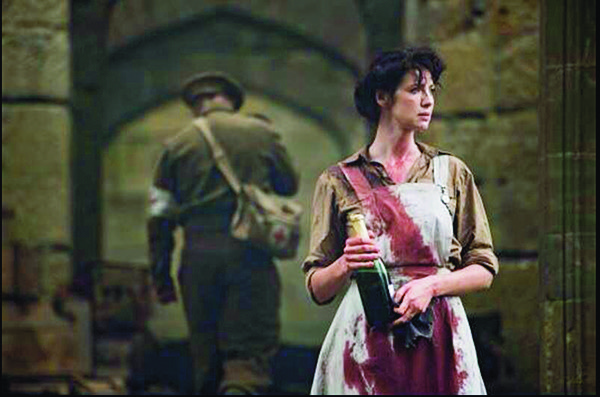
One of the most discussed ideas online is that Jamie Fraser’s presence across timelines — including the mysterious figure seen in early episodes — may not exist independently of Claire’s journey, but instead be connected to it. Rather than focusing on whether Jamie appears as a ghost or vision, the new theory reframes the question entirely: whether Claire’s existence in the past is what stabilizes the entire timeline in the first place.
Some fans describe this concept as a “time loop structure,” where cause and effect are no longer clearly separated. In this model, Claire does not just move through history; she becomes part of the mechanism that ensures it unfolds the way it does. This would mean the events of earlier seasons are not being rewritten or changed, but continuously reinforced through repetition.
However, not all viewers are convinced. Others argue that the series has always leaned more toward emotional storytelling than strict time-travel logic, and that the finale’s ambiguity is intentional rather than a clue to a hidden structure. For them, the idea of Claire shaping the timeline is less a literal mechanism and more a symbolic reading of her impact on the people and world around her.
Despite the disagreement, the theory has quickly become one of the most talked-about interpretations following the finale. Whether taken as a narrative framework or a metaphor, it reflects a broader shift in how fans are engaging with the series’ ending — not as a puzzle to be solved, but as a story about connection, fate, and the blurred boundaries of time itself.
As discussions continue to spread across social media, one thing is clear: Outlander may have ended its latest season, but fan theories about Claire’s role in shaping time are only just beginning.

Source: Various sources


