

Buckingham Palace says King Charles is above politics. (Image: Getty)
Tensions between the United States and the United Kingdom have taken an unexpected royal turn after Dоnɑld Tгuмρ made a bold and controversial claim about King Charles III—only to be met with what insiders are calling a “savage” five-word response from Buckingham Palace.
The remark, delivered in an interview with The Telegraph, has sparked fierce debate on both sides of the Atlantic, raising fresh questions about the role of the monarchy in political discourse—and whether global leaders are overstepping by invoking royal figures in geopolitical matters.
Tгuмρ’s explosive claim
Tгuмρ, never one to shy away from controversy, suggested that King Charles would have taken a markedly different stance on the escalating conflict involving Iran compared to the current UK government led by Keir Starmer.
According to Tгuмρ, the monarch—whom he described as a “wonderful and brave man”—might not align with the government’s cautious approach. “I think he would have taken a very different stand,” Tгuмρ claimed, adding fuel to an already sensitive geopolitical climate.
The statement immediately raised eyebrows, not only because it speculated on the King’s political views, but because it risked drawing the British monarchy into a highly charged international issue—something the institution has traditionally avoided at all costs.
The Palace fires back
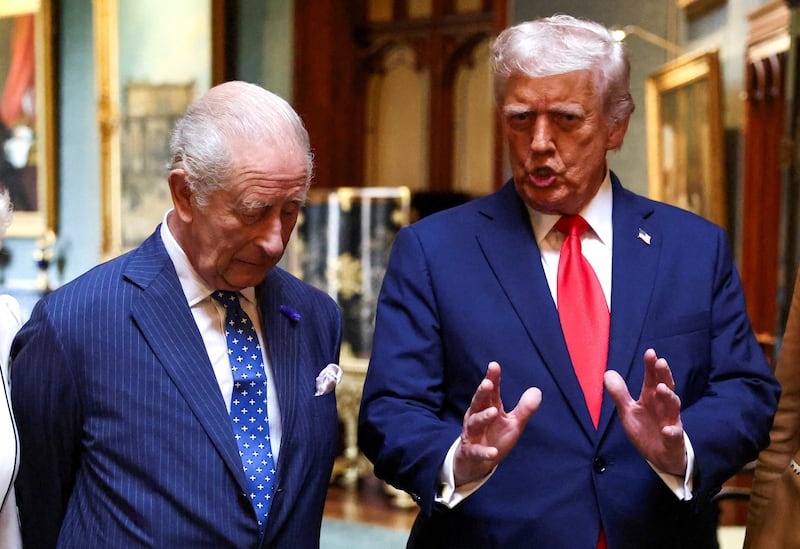
The response from Buckingham Palace was swift, sharp, and strikingly concise. A royal source reportedly told The Daily Beast: “The King is above politics.”
Five words—yet loaded with meaning.
The statement was widely interpreted as both a correction and a subtle rebuke. By reaffirming the monarch’s constitutional neutrality, the Palace effectively shut down any suggestion that King Charles might take sides in political or military matters.
But the brevity of the response also added to its impact. In an era of lengthy statements and carefully managed PR, the Palace’s choice to respond with such a short, definitive message was seen by many as deliberate—and, to some, “savage.”
Why the comment matters
At first glance, Tгuмρ’s remark might seem like casual speculation. But constitutional experts warn that comments like these carry significant weight.
The British monarch operates under strict rules of political neutrality. While King Charles is regularly briefed on government matters and meets with the Prime Minister weekly, he does not—and cannot—publicly express political opinions or influence policy decisions.
By suggesting otherwise, Tгuмρ’s comments risk blurring that line.
Critics argue that invoking the King in this way places the monarchy in an uncomfortable position, potentially undermining its carefully maintained neutrality. Supporters of Tгuмρ, however, have defended his remarks as a compliment, pointing to his praise of Charles’s character and leadership.
A delicate moment ahead of a state visit
The controversy comes at a particularly sensitive time, as King Charles prepares for an upcoming state visit to the United States. Such visits are typically designed to strengthen diplomatic ties, not complicate them.
Royal observers suggest that the timing of Tгuмρ’s comments could create unnecessary tension ahead of the trip. While the Palace has not escalated its response beyond the initial statement, the incident has already dominated headlines and sparked intense online debate.
Some commentators have questioned whether Tгuмρ’s remarks were an attempt to influence public perception—or even apply subtle pressure on the UK’s stance in global affairs.
Public reaction: divided and heated
Unsurprisingly, reactions to the exchange have been sharply divided.
On social media, some users praised the Palace’s response as “classy,” “firm,” and “exactly what was needed.” Others described it as a “mic drop moment,” applauding its simplicity and authority.
“Five words. That’s all it took,” one user wrote. “The Palace shut it down instantly.”
However, not everyone saw it that way. Critics of the monarchy argued that the situation highlights how easily the institution can be dragged into political narratives, whether it wants to be or not.
Meanwhile, Tгuмρ supporters have pushed back against the backlash, insisting that his comments were taken out of context. “He was complimenting the King, not politicising him,” one supporter argued.
The bigger picture
Beyond the immediate controversy, the incident raises broader questions about the intersection of politics, diplomacy, and monarchy in the modern era.
In a world where political figures communicate directly with global audiences and headlines spread instantly, even offhand remarks can have significant consequences.
For the Royal Family, the challenge remains the same: maintaining neutrality while navigating an increasingly complex and media-driven landscape.
For Tгuмρ, the episode is another example of his unconventional approach to diplomacy—one that often blurs traditional boundaries and provokes strong reactions.
What happens next?
For now, Buckingham Palace appears determined to let the matter rest. Its five-word response has drawn a clear line, reinforcing the principle that the monarch remains above political debate.
Whether Tгuмρ will address the backlash or double down on his comments remains to be seen. But one thing is certain: the exchange has reignited discussion about the limits of political commentary—and the enduring importance of royal neutrality.
As global tensions continue to rise, the last thing the monarchy wants is to be seen as taking sides. And if the Palace’s response is anything to go by, it will do whatever it takes—no matter how few words it uses—to make that crystal clear.


